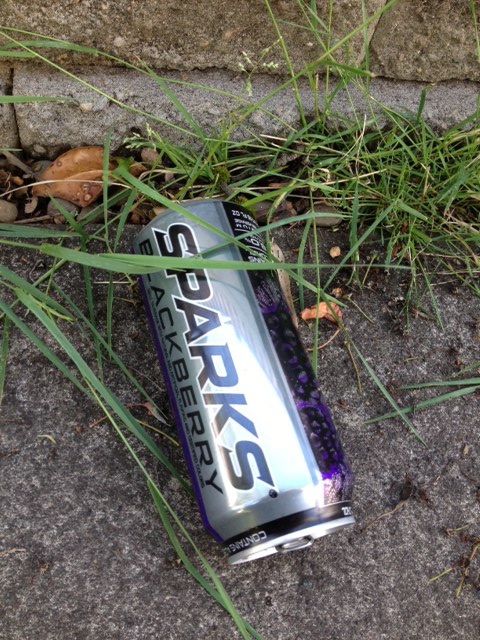
On the heels of introducing this new series of snapshots of discarded malt beverage vessels from my yard, here's a rather more expected discovery. See, ever since moving into a house on a corner across from a Fred Meyer, beer bottles and cans of every style and price point appear out front. Such is the inspiration behind this new series.
Here we have something a bit more expected, Sparks brand malternative, with a twist. A twist of blackberry that is. It seems the intoxicatee minds not the ban on caffeinated alcoholic beverages, and since this souse can't obtain 4Loko, he or she but most likely he fell back onto a pint-sized can of Sparks Blackberry brewed by Steel Brewing Co., a subsidiary of MillerCoors. Classy, Adolph Coors and Frederick Miller.
May 14, 2013
May 13, 2013
Portraits of dead soldiers left in yard #1: BridgePort India Pale Ale
Years ago, while driving through Missouri, I got a call, but not on my cell phone. It was Nature. So I pulled over. That's when I first pondered the nature of beer litter. The ditch was full of empties, a bad sign considering it was the middle of nowhere and that meant the drivers discarding them were clearly driving under the influence. But then I noticed that, without exception, all the dead soldiers with macro brewed lagers, often of the budget variety such as Busch Light and Keystone Ice. I even wrote about it in my book, which you can find on pages 83-84. I'd mused, "Does that mean that domestic beer drinkers are more prone to littering and craft beer drinkers understand that trash belongs in trashcans, or better yet, recycling bins?"
Ever since moving into a house on a corner across from a Fred Meyer, a Kroger-owned one that stocks and sells more craft beer than any supermarket in the nation or so I've been told, I've changed my tune. Beer bottles and cans of every style and price point appear by our fence, in our yard, piled on the stairs, or sometimes stashed in a tree out front. Such is the inspiration behind this new series: Portraits of beers left in yard.
We begin with the noble BridgePort India Pale Ale, the trailblazer for Oregon's most popular style of beer, and craft brewing in general. Whoever littered it high within this tree proves he or she but more than likely he knows from full-flavored beers rich with hops. He could maintain his wits by drinking this sessionable 5.5% beer, but perhaps this was the last in his 6-pack and didn't have enough sense not to plant it in my front yard.
April 1, 2013
Portlandia Bröø Vërks in the works
Andrew Singer and Jonathan Krisel, producers of IFC’s hit TV show, Portlandia,
announced that series stars Fred Armisen and Carrie Brownstein are launching a
brewpub on NE Killingsworth adjacent to In
Other Words feminist bookstore frequently spoofed on the program in the “Women
and Women First” sketches. The space, vacated by The Record Room, formerly
served as a cherished vinyl lounge offering craft beer until Portlanders eschewed
vintage LPs and shifted en masse to digitally formatted recorded music mirroring the trend away from bikes toward mopeds and motor-assisted bicycles.
Emulating In Other Words’s not-for-profit status, the
brewpub, to be called Portlandia Bröø
Vërks Und Das Public Haus, will operate as Portland’s first nonprofit pub.
As news leaked, Oregon Public House
quickly opened overnight to capitalize on the concept, moving so quickly it’s
as if the operators had been planning it for over two years.
The series creators and actors announced their opening
line-up of draught beers, named after characters and phrases the satirical show
popularized. Put a Bird on Wit is a sourpuss of a Belgian Witbier. (In related
news, Armisen and Brownstein are suing
Flat Tail Brewing from Corvallis for copyright infringement). Portlandia
Pils will be their super-hopped summer Pilsner. (In related news, Armisen and
Brownstein issued a Cease & Desist to Laurelwood
Brewing.) Pickle That IPA will not be on tap, but rather available only in
tallboy cans with the slogan "we
can Pickle That." And they have mixologized a Martini Saison called
Dream of the ‘90s is Olive in Portland, dry-hopped with three locally sourced,
certified-organic, gluten-free, heirloom olives.
The brewpub is executive produced by Lorne Michaels.
March 5, 2013
Neglected Portland-area Breweries: Off the Rail (R.I.P.)
Portland has some 50 breweries and counting, 70 if you count all of Portland Metro. Many are world-class, even out-of-this-world, but not all. If we're being honest, a handful generally have no Beer Geek Brownie Points, deservedly so or not. Here's Pt. VIII in an ongoing series that included Tugboat, Philadelphia's Steaks & Hoagies, Max's Fanno Creek, Broadway Grill & Brewery (Old Market Pub), Widmer Bros (note the post date), Columbia River Brewing Co., and The Mash Tun: Neglected Portland Breweries.
Forest Grove’s Off
the Rail Brewing Co. has powered down after a dozen years of brewing up
Black Sabbath inspired beers. None of their beers contained copious illicit
drugs or bats, but beers like War Pigs Wheat and Over the Mountain Stout
at least indicate what was blaring in the 12-barrel brewhouse run by brewer Dan
Bragdon and his wife Antoinette.
“We kept to ourselves,” said Antoinette, which explains why
the Bragdon family—their kids have all done time at the brewery—were phantoms
of the local beer scene despite self-distributing to many neighborhood watering
holes. For my local, that meant Nick’s Famous Coney’s in the Hawthorne
District, which always had Over the Mountain Chocolate Stout on tap. Silver
Dollar Pizza downtown was a reliable source for Sweet Leaf Amber, while
two of The Waypost’s five taps in the Eliot neighborhood recently proffered
Coal Porter and Paranoid
IPA.
In the end, the Bragdons didn’t point to lagging sales but
said it was a “personal decision. It wasn’t business.” In an era with
increasing competition from ever-opening breweries (around 175 in Oregon) and
ever-expanding ones at that, OTR Brewing self-distributed to accounts from
Portland to Corvalis. “(The brewery was) more of a passion and a hobby. Dan and
I are happy and positive with our decision.”
I’d learned about the closure at the beginning of this year,
but per Antoinette’s request, kept mum. When the story involves medical issues
warranting emergency responders as well as a son returning home after being
stationed in Afghanistan, getting the scoop on a rare Oregon brewery closure
matters very little. Perhaps what’s most telling is that in the two months
since, absolutely nobody seems to have noticed.
March 3, 2013
Beer Birthday: Jay Brooks
Today is the birthday of beer writer Jay Brooks. Jay is a veteran beer writer (Celebrator Beer News, All About Beer, BeerAdvocate, etcetera etcetera) whose column Brooks on Beer appears in the San Jose Mercury News. He has contributed to the Oxford Companion to Beer as well as Playboy Magazine. His guidebook, California Breweries - North (Stackpole Books), comes out later this summer. He is the co-founder of SF Beer Week (and it broke my heart to miss it for this first time in its fourth iteration last month). To anyone who follows the brewing industry, none of this is news. But for years, a convivial component of his Brookston Beer Blog has been celebrating brewers and those in the beer community on their birthdays. So please...join me in wishing Jay a very happy birthday.
Brewmaster Craig Cauwels, yours truly, the Beer Chef Bruce Patton, the birthday boy
Beer bloggers Jay Hinman, Chris Cohen, Steve Shapiro, Jay Brooks, moi, Bryan Kolesar
Outdoor Speakeasy: Me, Brian Lenzo, Jay Brooks (whose blog I copied this from), and Meg Gill
Brewmaster Craig Cauwels, yours truly, the Beer Chef Bruce Patton, the birthday boy
Beer bloggers Jay Hinman, Chris Cohen, Steve Shapiro, Jay Brooks, moi, Bryan Kolesar
Outdoor Speakeasy: Me, Brian Lenzo, Jay Brooks (whose blog I copied this from), and Meg Gill
January 7, 2013
Neglected Portland Breweries: The Mash Tun
Portland has some 50 breweries and counting. Many are world-class, even out-of-this-world, but not all.
The reason for the visit wasn't actually so I could finally haul my butt into the solitary brewing company based in Portland--The Mash Tun--that I'd yet to visit, although naturally that did influence the decision. No, Half Pint and I went (along with our friends John and Anna who pronounces her name not like the latter half of banana but like the end of the Spanish word for tomorrow, and I confess we refer to them as Johnna in our house) because our son I.P.Yae turned 1 on Sunday and I pledged to escort him to 50 breweries by his first birthday. (Actually, I aimed for 52 and with wifey's help, we achieved our feat!)So onto the experience. The Mash Tun, brewing since 2005 thus making it a veritable veteran of Beervana, gets zero lip service but it has something better than blog-love: patrons. The place with no sign above the entrance just around the corner on NE 22nd Ave from it's Alberta address (there's a beer garden that's certainly hopping in non near-freezing weather) was packed on a chilly Friday night. Our waitress was very sweet and attentive, but we could tell she wanted us to order when we kept saying we were waiting for a fourth (fifth; sorry IPYae). The interior is mostly wood (well, obviously the brew house visable through picture windows is stainless) including a pool table in the center and a dart board tucked behind the front door. Lots of hanging plants are a nice, lively touch.

Check in on Yelp and your first pint's FREE. Not that you'd walk out of here dropping a lot of coin; the prices are reasonable. Anna, John, and I all opted for the Keelhaul IPA, billed as "herbal and citrus" hop flavors with "sweet and nutty" maltiness, but I got lots of lemon notes and didn't mind the lack of ballyhooed malt backbone (though at 7.2% ABV it's there). Half Pint of course got the Penfold Porter, then got it again. Good malt-driven cocoa flavor.
Curiously, no one got a burger. I nearly went for the Dragon Burger, but even as a chiliphile I've had two jalapeno dishes this week and both set my mouth en fuego so I played it safe and got the cheesesteak that beckoned. It had Half Pint's and John's number, too. Decent. No mistaking it for actually hailing from the City of Brotherly Love, or even Cheesesteak Nirvana.

We all opted for another round. Johnna stuck with the IPA. Half Pint as I mentioned ordered another Porter, this time an actual half pint. I do something I rarely do: ordered a cream ale. Concordia Cream Ale entails flaked corn so I worried that while I wanted light, I'd also get sweet, but the beer is saved by sufficient local aroma hops to make it palatable to beer lovers and at 4.5%, perfect for lightweights like me.
All in all, the Mash Tun is like Cromagnon Man on the human evolutionary chart--a good snapshot of how far brewpubs had come since the early '80s to the mid-aughts and then gets frozen in time. Maybe it's the caveman in me, but I think this analog brewpub is a pretty good respite in this digital age. And the packed place proves we paleos travel in packs.
November 26, 2012
Cask ADIA
It's a good thing smaller, authentic, independent breweries have adopted the term "craft brewery" over the antiquated "microbrewery." The way some of them operate is anything but indicative of how the little guys play ball. Trademark suits have become as common as the California Common.
I use the vaunted "Cal-Common" reference because, much like Anchor Brewing igniting the entire craft beer industry (first post-Prohibition all malt beer, first IPA, first barleywine, etc, etc.), it introduced the first craft beer trademark--Steam™--in 1981 before the 2,000-plus "new kids" had even germinated.
What started out simply enough as a way for
two stellar brewers--Adam Avery from Avery Brewing in Colorado and Vinnie
Cilurzo from Russian
River in Northern
California--to settle a caused by both breweries offering Belgian Strong Ales
called "Salvation" turned into the blend of both beers and the
resulting "Collaboration, Not Litigation." That was just the
beginning.
Collaboration beers may just be the epitome
of why the craft brewing industry is so awesome. Other competitive businesses
revolve around games of one-upmanship—OUR product is 15% bigger, twice as
refreshing, and 100% sexier—but today’s independent brewers are
collectively deciding that what’s good for one is good for us all. The result?
Many are now brewing in tandem. Others, undoubtedly, will join the fray.
October 23, 2012
My 1st GABF
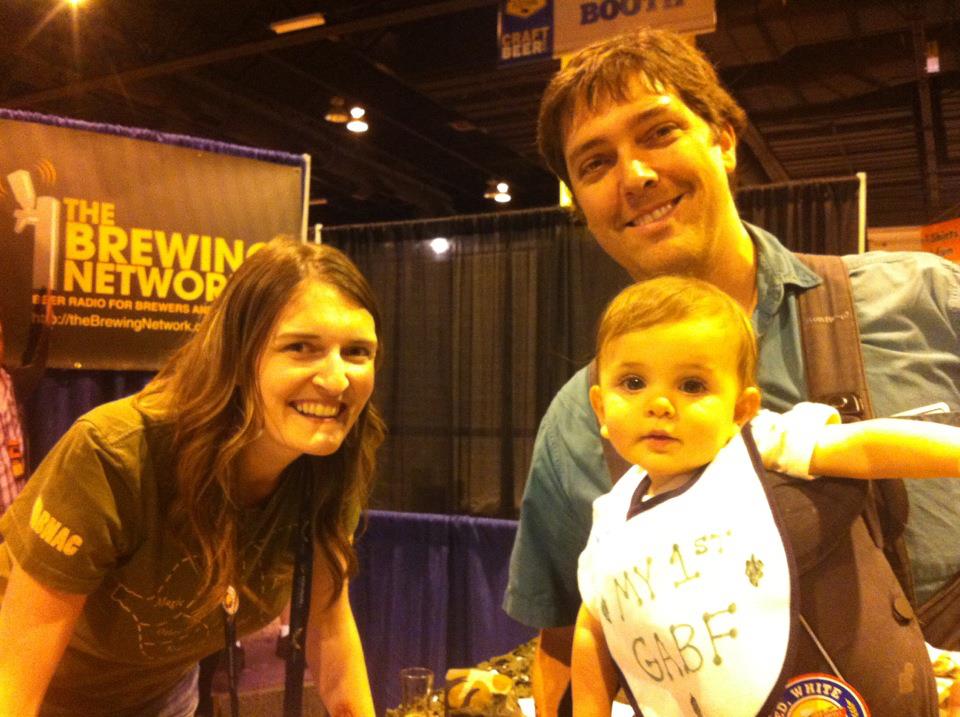
Our baby boy's no stranger to the beerfest circuit. I like to say Oregon has 53 beer fests because there's seemingly more than one a week. But this was his first time at the big dance. Great American Beer Festival. And in no small way, he has the GABF to thank for his existence. His mom, Half Pint, went for the first time in 2008 when my book came out and hustled outside the Beer Enthusiast Bookstore to help sell a ton of books. She drove out with me again the next year and by the time we got to Denver, she was my fiance. Next year, she was there as my wife. Since we love measuring our life events in terms of GABFs, it's only fitting that we returned this year as parents. And even more fitting that we've turned into chopped liver.
![]() |
| He was able to bob'n'weave through the crowds. |
Obviously, he didn't do any beer sampling, but he did enjoy the sampler flight...of pancakes from Snooze. And he picked up an awesome li'l Yeti onesie from Great Divide Brewing on our walk back (photo T/K).
But that was hardly the only brewery he hit. I double checked to make sure we could bring him on the media bus tour. I heard the guide on the other bus was in disbelief someone brought a baby. He wasn't alone. But first... First stop of the tour, Mountain Sun's Vine Street Brewery. Brand new and tapping 21 -- TWENTY-ONE -- house beers. I definitely thought the IPA and Saison were right on. And it's a hippy-dippy hangout of a brewpub.
![]() |
| Next stop: the new River North Brewery, beers made w/ a Belgian yeast strain |
OK, where were we?
Not everyone who goes to Denver feels this way, but we feel the real highlight of GABF is the fest itself. Beyond the endless one-ounce samples, it's the one place you're likely to bump into old and new friends and members of the beer family at large. Look: IPYae's first fist-bump with Charlie Papazian.
While standing in the bookstore, Izzy met Jack McAuliffe, the man who opened the very first microbrewery post-Prohibition! That was 36 years ago. GABF is on its 31st year. While this naturally was Izzy's first, it was only Jack's second time attending, his New Albion Brewery having gone under before GABF was even a thing.
Author Maureen Ogle did much for revamping interest in those early days of microbrewing and clutching Jack back from obscurity. As Izzy's beery godmother, I think no one looked forward to meeting him more than her. Who else could get her to crawl around on the floor?!
![]() |
| No live recording this year, so this is the closest IPYae gets to being on The Brewing Network. Kate's a fan. |
![]() |
| Portland boys: SNOB Ritch Marvin, "Samurai Artist" Ezra Johnson-Greenough, Breakside's Scott Lawrence. |
We do. And unlike their parents, we were very proud of how he handled himself.
| Photo credit: Matthew Schniper, courtesy of the Colorado Springs Independent |
September 5, 2012
The Session #67: How many breweries in 2017?
My buddy Derrick Peterman over at Ramblings of a Beer Runner hosts this month's The Session. Man it's been awhile since I've joined the fray. Derek opens:
Oh, I should extrapolate? Well, it's like this. Yes, there are well over 2,000 breweries already. The Brewers Association further purports that there are over 1,600 BIP (breweries in planning)! True, not all of them will brew in the light of day (and to be sure we will see a huge bump in the number of failed/shuttered brewing concerns, but it will long be outpaced by new and succeeding ones). But blink and the number of brewery-opening hopefuls has already risen, so let's just say that by early 2014 when all their i's are dotted and they've navigated the alphabet soup of ABCs and TTBs, etc, there will be nearly 4,000.
"Impossible!" you say? Why? A recent Gallup poll concluded that Americans prefer beer to wine 39% to 35%. So it stands that there should be 4% more breweries than wineries, right?! (Hey, I'm a wordsmith, not a mathematician.) OK, but really, my point is that it'd be logical that since more Americans prefer beer to wine, there should be more breweries. Or at least the same amount. Fine, how about at least HALF as many!? But no, as it stands today, there are 7,626 bonded wineries in the USA. That's fewer than 28% as many licensed breweries as bonded wineries.
So where are the remaining 2,875 breweries going to come from that I'm predicting will open by 2017?
Tiny, nano, pico, "boutique," retirement-plan, post-law-career, I've-always-loved-homebrewing-and-all-my-friends-said-I-should-go-pro breweries. One of the biggest arguments against the success of more packaging breweries is that shelf space remains finite. So clearly we cannot have nearly 3,000 new "regional" breweries concocting over 15,000 barrels apiece. But people love supporting local and that's just not a fad or trend that will dissipate. Once people get a taste for serious, flavorful, characterful beer, they do not revert back to the industrial, commoditized swill. And if my hometown of Portland can support 50 breweries--yes, 50 breweries in a city with just over 1/2 a million folks--then so can other progressive towns. And if littler hamlets such as Asheville, Bend, and Grand Rapids can support over a dozen breweries, then who's to say many more with less than a 1/4 million residents can't do the same?
Craft beer consumers are savvier than they've ever been. The mid-90s bust needed to happen; too many bogus breweries needed to have bullshit called upon them. But now, there's a more knowledgable and talented pool of prospective brewers/brewmasters. The AHA estimates that there are a million homebrewers in this country. I'm one of them and I have zero aspirations of going pro. But if only 0.002875% of them do seriously plan on making an avocation their vocation, then welcome to a world with over 5,000 breweries.
There's been much cheering and fanfare reverberating throughout the brewing community about the latest brewery numbers recently released from the Brewer's Association, who counted exactly 2,126 breweries in the United States.The theme he suggests us beer bloggers blog about is:
Where is it all going? The growth shows no sign of stopping and the biggest problem most breweries have is that they can't brew beer fast enough. But can the market really absorb all these new breweries?...Tell us how many breweries the Brewer's Association will count five years from now in 2017, and why you think it will be that number.Answer: 5,001.
Oh, I should extrapolate? Well, it's like this. Yes, there are well over 2,000 breweries already. The Brewers Association further purports that there are over 1,600 BIP (breweries in planning)! True, not all of them will brew in the light of day (and to be sure we will see a huge bump in the number of failed/shuttered brewing concerns, but it will long be outpaced by new and succeeding ones). But blink and the number of brewery-opening hopefuls has already risen, so let's just say that by early 2014 when all their i's are dotted and they've navigated the alphabet soup of ABCs and TTBs, etc, there will be nearly 4,000.
"Impossible!" you say? Why? A recent Gallup poll concluded that Americans prefer beer to wine 39% to 35%. So it stands that there should be 4% more breweries than wineries, right?! (Hey, I'm a wordsmith, not a mathematician.) OK, but really, my point is that it'd be logical that since more Americans prefer beer to wine, there should be more breweries. Or at least the same amount. Fine, how about at least HALF as many!? But no, as it stands today, there are 7,626 bonded wineries in the USA. That's fewer than 28% as many licensed breweries as bonded wineries.
So where are the remaining 2,875 breweries going to come from that I'm predicting will open by 2017?
Tiny, nano, pico, "boutique," retirement-plan, post-law-career, I've-always-loved-homebrewing-and-all-my-friends-said-I-should-go-pro breweries. One of the biggest arguments against the success of more packaging breweries is that shelf space remains finite. So clearly we cannot have nearly 3,000 new "regional" breweries concocting over 15,000 barrels apiece. But people love supporting local and that's just not a fad or trend that will dissipate. Once people get a taste for serious, flavorful, characterful beer, they do not revert back to the industrial, commoditized swill. And if my hometown of Portland can support 50 breweries--yes, 50 breweries in a city with just over 1/2 a million folks--then so can other progressive towns. And if littler hamlets such as Asheville, Bend, and Grand Rapids can support over a dozen breweries, then who's to say many more with less than a 1/4 million residents can't do the same?
Craft beer consumers are savvier than they've ever been. The mid-90s bust needed to happen; too many bogus breweries needed to have bullshit called upon them. But now, there's a more knowledgable and talented pool of prospective brewers/brewmasters. The AHA estimates that there are a million homebrewers in this country. I'm one of them and I have zero aspirations of going pro. But if only 0.002875% of them do seriously plan on making an avocation their vocation, then welcome to a world with over 5,000 breweries.
August 31, 2012
Dunkel saved by his church key
Getting press releases and samples of actual beer is nice. Getting releases for gizmos and doodads aimed at beer-lovers often merely strikes a chord of amusement or befuddlement. Such was the case when the folks behind the Pop Tag landed in my inbox wagging their tails about a bottle opener converted into a dog tag so that the ability to open your beer "is just a whistle away" and that "It gives a whole new meaning to man’s best friend!"
Cute, but I still likely would've filed it under Delete, had my cuddlesome canine not gone on a walk unescorted that day. I got a terse phone call from my wife alerting me to his whereabouts since it's her number on his tag. If you're a pet owner: consider if you've moved or changed numbers since you had a dog tag engraved.
Before I accepted the offer of the sample, I asked if there was any danger of the opener portion somehow catching the scruff of a dog's neck.
The ID tags come with a removable silicone bumper so that it won't hurt if Dunkel is running and the tag is bouncing around!I thought that was a rather fetching idea. They know Dunkel so well. Dunkel, since he's been mentioned here but never properly introduced despite rescuing him over two years ago, is a German Shorthair Pointer mix. Given his provenance and coat, and the fact that I couldn't come up with a better German beer style name for him, his full name is Dunkel Weisse. (A dark wheat beer that also means dark-white, like his coloring.) He only gets called that when he's in trouble. Which brings me to something else the folks at Pop Tag said.
We wouldn't want Dunkel to wander off and only be able open the beer of the kind stranger that finds him!Perfect timing to test this tag out! Yesterday I got a phone call from some folks saying he was in the patio area (biergarten?) of Pepino's, Half Pint's favorite Mexican take-out spot two blocks away. The new tag, with my current number, saved his life. And yes, I did offer to buy them a beer and/or burrito but they'd just finished their lunch. Dunkel Weisse is safe back home, firmly in the dog house.
June 18, 2012
Distill my beating heart: A whiskey odyssey
Boston Beer Co., makers of Samuel Adams, announced today a partnership with Berkshire Mountain Distillers--their in-state brethren purveying adult beverages--to create two whiskies literally made from two different Sam Adams beers including the flagship Boston Lager.
The story was picked up by several news outlets including the Wall Street Journal. It's a new frontier for craft brewers and distillers to be sure. But the press release chose its words carefully to insinuate, but not state, that Jim Koch is the Christopher Columbus discovering this new world (though maybe that's an apt comparison since Chris gets the credit but hardly "discovered" an already inhabited frontier).
As I'd reported in a Draft Magazine story in 2010, "Whiskey is a distillate made from 'low wash' or 'distiller’s beer,' meaning it contains the same malted grain, water and yeast that all beer has. The difference is that the beer we drink is bittered, usually with hops." The story was about Charbay, a winemaker and distiller in the San Francisco Bay Area using various beers, predominantly from local Bear Republic Brewing, to turn into whisky whereby master distiller Marko Karakasevic uses " a copper alembic pot (to make) cuts to the distillate to ensure only the hearts—the most desirable liquid—and not the heads or tails, remain." (That other stuff is the reason moonshine has a reputation for making you go blind.)
Oddly, the WSJ story also notes that Boston Beer isn't the first brewing company to get into the microdistilling biz. (Those who've tasted Utopias, first introduced in 2002 and clocking in usually at 27% alcohol but more like 54-proof, would say they're already selling cognac or something close to it.) It says that Rogue from Oregon, "for example," started distilling in 2003. Other breweries-cum-distilleries include Dogfish Head and Ballast Point. But I'm curious why they didn't just point to Anchor. Established in 1896, it famously launched the craft/micro brewing revolution in 1965 when Fritz Maytag salvaged the brewery. The microbrewing renaissance didn't begin until over a decade later. Maytag did the same with whiskey and craft distillation in 1993 when Anchor Distilling was born.
The first time I'd interviewed Fritz, he said, “In the eighties when all the competition came in the brewing world, some of the fun went out of it. Then I found out that no commercial American whiskies were made in a traditional manner. When I heard that, I realized, we’re going to make an all-malt, pot-distilled rye whisky aged in uncharred barrels. You don’t put hops in it, but whisky is really distilled beer.”
The Boston Beer Co. deserves a tremendous amount of credit as an early pioneer in the good ol' days of better beer. Starting in 1984, Koch put a better product in front of millions of Americans and had the gumption (and advertising moolah) to convince them they could be drinking a better tasting beer. They now release 40-some-odd active beers a year. And while they were the company behind Hard Core Ciders, they've things up quite a bit with Angry Orchards brand ciders. Can their foray into the world of winemaking be far behind?
Perhaps they're waiting until 2015ish to see how the whiskies do.
Subscribe to:
Posts (Atom)